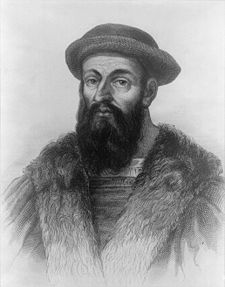
...or the Pilipinos discovered Magellan and suffered 400 years of cruelty under Spain’s colonization. Instead of losing to the revolution initiated both by Cuba and the Philippines, Spain sold her four remaining island colonies, including Guam and Puerto Rico for $20,000,000. to the Americans - in 1898 Treaty of Paris. The church and the colonial government of Spain, positioned and glued in our mind, that the reason for their colonization is to “save our soul.” A lot of people really don't know much about Magellan...he was a great explorer, "discovered the Philippines" he was Portuguese and the rest we don’t really know.
Just like Columbus’ past and remains which still a big unsolved mystery. Most history books stated that Columbus was born in the coastal town of Genoa, Italy. Some researchers now are saying that he was Catalan from Catalonia, Spain after a long investigation and research basing on his choice of words, style of writing in Spanish of the day to day accounts he wrote in his diary. Was he Italian, Spanish or Catalan? His remains is more mysterious than his origin, a lighthouse called “Faro a Colon” (Lighthouse of Columbus), in Hispaniola now the Island of Santo Domingo house a box said to contain his bones. Santo Domingo’s government claimed that this box came from Seville, Spain in 1542, was requested by Don Diego, son of Columbus who was the Governor during that time. There are also Columbus’ bones in a box inside a tomb made of ornate bronze, in Seville’s Cathedral, Spain, claiming his remains.
Why do most of these "great explorers" have questionable or little known past? Simple, most of them were mercenaries, criminals, ex-convicts, pirates, thieves or treasure hunters. By bringing looted goods, treasures and new colonies to their King, their past were forgiven or covered. Instead they were given titles and power by the King or Queen who sponsored their exploration. Sir Francis Drake was a pirate, his ship “The Golden Hind” was the second ship in history that sailed around the globe, looting Dutch, French cargos, Spanish galleons, even English ships. Drake was responsible for the ignominious slave trade. Trading rum (which was part of crew's ship compensation) and sugar from Cuba, selling the goods in Europe, using the profit to purchase African slaves in slave markets of West Africa, then sold and traded slaves in Cuba! He and his crew were fugitive by The English Navy, until he brought gold from Spanish colonies and looted goods to the Throne of England, Sir Francis Drake was knighted.
Before Magellan, the China Sea functioned as a Mediterranean. The people along its littoral were long in contact with each other, which had of course, cultural consequences. It was possible that the Philippines was visited and traded with the famous Chinese-Muslim Admiral Zheng He, a great sailor historians credited that he was the first person to reach the Americas. The Philippines was one of the most important centers of Chinese commerce. Chinese chronicles and old maps refer to the country as MA-I ("The Three Islands") that may well refer to the three big islands. Pasig River was a long stretch highway used in trading between the Taga Ilog (Tagalog) and the Chinese. Arabs traded with the natives of Mindanao and shared their Muslim faith. The Hindus from India traded in southern Philippines and shared their titles “Raja” with us. All these exchanged of goods, faith, culture and ideology happened before the time of Magellan and none of these traders claimed they “Discovered the Philippines”
Magellan having lived in India and the Portuguese colony Malacca or Moluccas, must have heard or knew the Philippines from Hindu, Chinese and Malay traders. Magellan was in Cochin in 1512, participated in the attack on Goa, India, sailed as far as Moluccas in Malaya, where he purchased a 13 year old slave latter, named him ENRIQUE or “Enrique de Malacca.” Magellan is like a father to Enrique and Magellan was fond of his page. Magellan wrote in his will that when he dies, Enrique would be a freeman. Magellan and Enrique took part in fighting the Moors in Morocco, fighting English pirates at sea which made Enrique famous for his courage, pirates called him "BLACK HENRY" Enrique or HENRY in English, BLACK - because of his skin color. At the battle of Azamor, Magellan received wounds, slashes of sword left him scars on his face and a deadly cut in his knee that left him permanently lame. Afterwards, he entered the customary claim for a larger allowance from the king of Portugal. It was refused, with the imputation that Magellan was entirely cured. His honor was insulted; he not only left his country but published a formal renunciation of his Portuguese citizenship.
Took his page Enrique, his friend Ruy Faleiro, a geographer and astronomer of Lisbon, whom from him, Magellan learned his navigational skills all went to Spain in 1517 and became Spanish citizens. While in Seville Magellan married Beatriz Barbosa and fathered a son Rodrigo.
With Magellan's experience in Malacca, courage, and his navigational skills, the king of Spain was impressed by Magellan's qualities and agreed in 1518 to supply him with men, supplies and 5 ships, Trinidad, Magellan’s flagship, San Antonio, Concepcion, Victoria and Santiago. In return, over half the profits from any products Magellan might bring back were reserved for the Crown. Juan de Cathergena – captain of San Antonio, Luis Mendoza – captain of Victoria, Gaspar Quesada – captain of Concepcion and Magellan’s Portuguese cousin, Joao Serrao – captain of Santiago. Luckily Magellan had a passenger, a civilian tourist, going along simply for the adventure of the trip. He was the 28 year old ANTONIO PIGAFFETA, a native of Vicenza, Italy. The only person who documented the trip, which the journal he wrote was the only basis of the first circumnavigation of the world of the ship "VICTORIA." August 10, 1519 the crewmen, all 270 or so assembled at dawn for a solemn Mass. Before reaching the Pacific, the smallest ship Santiago having been wrecked on a scouting mission. The ship San Antonio, sailed behind one of the islands in South America, turned back to Spain. The 3 remaining ships left South America on November 28, 1520, entered an unknown ocean to continue the voyage that answered the question "is the world round?" Discovered unknown countries, territories, straights, International Date Line and the world largest body of water the "Pacific Ocean."
After 3 months of sailing an endless but calm ocean, Magellan named it “Pacifico” meaning peaceful. Dying of hunger and thirst, the crew ate their last worm-filled biscuits and went hunting for rats. Luckily they came across a small island, where they landed get food and water. The natives of the island traded with the crew, but stole one of their life boat and goods. Magellan being mad with what happened, ordered his crew to burn the village and named the island “LADRONES” or Island of Thieves. March 6, 1521, ten days after leaving Ladrones, now Guam, Magellan landed in Limasawa held thanks giving mass. He named the place "San Lazaro", for it was St Lazarus day. The crew was amazed with Magellan's page ENRIQUE, the natives were able to communicate with him and acted as an interpreter.
Six weeks later, sailed to the island of Cebu, where they were welcomed by the natives lead by their king Raja Humabon. Being the first two Pilipino collaborator/balimbing in Philippine history, Raja Humabon and Datu Zula convinced Magellan joined them in battle with the neighboring island, Mactan ruled by Lapu Lapu. Magellan to show the power of “modern weapon and warfare” promised to lead the raid himself taking only 60 men. Being low tide during the time of the battle of Mactan, Magellan’s ships failed to be close to shore to be able to fire and reach Lapu Lapu’s village.
*from Pigaffeta’s diary…
“When morning came, forty-nine of us leaped into the water up to our thighs, and walked through water for more than two cross-bow flights before we could reach the shore. The boats could not approach nearer because of certain rocks in the water. The other eleven men remained behind to guard the boats. When we reached land, [the natives] had formed in three divisions to the number of more than one thousand five hundred people. When they saw us, they charged down upon us with exceeding loud cries... The musketeers and crossbow-men shot from a distance for about a half-hour, but uselessly... Recognizing the captain, so many turned upon him that they knocked his helmet off his head twice... A native hurled a bamboo spear into the captain's face, but the latter immediately killed him with his lance, which he left in the native's body. Then, trying to lay hand on sword, he could draw it out but halfway, because he had been wounded in the arm with a bamboo spear. When the natives saw that, they all hurled themselves upon him. One of them wounded him on the left leg with a large cutlass, which resembles a scimitar, only being larger. That caused the captain to fall face downward, when immediately they rushed upon him with iron and bamboo spears and with their cutlasses, until they killed our mirror, our light, our comfort, and our true guide. When they wounded him, he turned back many times to see whether we were all in the boats. Thereupon, beholding him dead, we, wounded, retreated, as best we could, to the boats, which were already pulling off.”
Magellan lost his life along with forty of his crew on April 27, 1521. After Enrique’s master, Magellan’s death, the remaining Spanish Captain refused to give Enrique his freedom. Enrique sought out the disillusioned Raja Humabon and Datu Zula, convinced the two “balimbing” about his plot to get the Spanish goods and kill the crew, which the two agreed. Enrique told the Spanish crew that Raja Humabon is giving them a farewell banquet and gift of jewels. Greedy, 29 officers came ashore for the party for food, wine and favors from Humabon’s women. Enrique’s vengeance was completed in the massacre that followed. The remaining crew, scared, confused and not knowing what to do, sail southward. Enrique was left behind by the 3 remaining ships; one of them was leaking and was destroyed.
The Victoria and Trinidad set out for Borneo. In November reached the Moluccas-Tadores. In December, they sailed southwest and separated. The Trinidad tried to recross the Pacific, but was forced back by headwinds to the Moluccas, where she was captured by a Portuguese squadron. Victoria with her valuable cargo, under a Basques captain Sebastian Del Cano, had touched Timor, and then crossed the Indian Ocean early in 1522. She rounded Cape of Good Hope in May. In a final run to Spain the Victoria anchored in Seville on September 8, 1522, after 3 years at sea. The cargo of the Victoria was sold for enough money to pay for the expedition! Del Cano was rewarded with a pension. Pigaffeta presented to Charles V his diary, or a copy of it, whereabouts is not known today. He visited Portugal, where he gave the king a manuscript, then to France and gave it to Marie Louise, regent and mother of Francis I.
ENRIQUE, Enrique de Malacca or Black Henry as he was called, was the first man to circumnavigate the world. Magellan's journal described Enrique's origin, as not a native of Malaya, but from somewhere else. According to Tome Pires's "Summa Oriental", people from Luzon and other parts of the islands, was living in the Malay Peninsula when the Portuguese conquered Malacca in 1511. Enrique was a captive warrior in Malaya and was sold as a slave, possibly a victim of the practice of slave-raiding. Was the knowledge of Enrique about the area made Magellan confident, convinced King Charles I of Spain and was sure of the expedition? Was this the reason why Magellan “knew the area” so well? Not like Columbus who sailed west to reach India failed, reached America instead, and still believing he made it to India called the Native Americans “Indians.” Like Columbus, Magellan sailed west and reached Asia, as he expected. Was it with the help of Enrique, like his people from Asia who sailed east on their simple and small boat and reached tiny islands of Micronesia and Polynesia? Was Enrique then a Pilipino? Pigaffeta, the Italian scribe of Magellan's expedition was quite explicit in his observation that Enrique spoke and understood Visayan, had familiarity of the geography, rejoined the natives after the battle of Mactan. With the Cebuanos he led a plot to kill more Spaniards, stayed in Cebu and blended with his roots. Pilipino? I really think he was.
ka tony
the 16th of March, 2007


